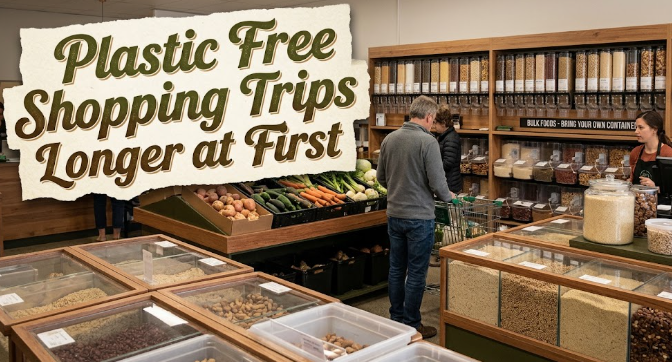
Plastic Free Shopping Trips Take Longer at First
The first plastic free grocery run takes almost twice as long as a normal one. Nobody warns you about that part. They tell you about the jars, the bulk bins, the tote bags folded neatly by the door, but not about standing in the pasta aisle reading four different labels because you’re trying to figure out which brand ships in cardboard instead of a plastic window.
That slowdown is normal. It is also temporary, though it rarely feels that way in week one.
1. Why the First Few Trips Feel So Slow
A regular shopping trip runs on autopilot. You know which shelf has the rice, you know the brand of oats you like, you’re in and out in twenty minutes without thinking about a single decision. Plastic free shopping strips all of that away and forces you to rebuild the map from scratch.
You’re not just buying groceries anymore. You’re evaluating packaging, checking whether the bulk bins are self-serve or staff-served, working out if you brought enough containers, and occasionally standing there doing mental math about whether a glass jar of tomatoes is actually a better trade than the plastic pouch next to it. Every one of those decisions costs a few seconds. String enough of them together and a twenty-minute trip becomes forty-five.
We’ve written before about how the first week of going plastic free tends to feel harder than people expect, and the extra time at checkout is one of the clearest examples of that. It’s not that plastic free living is inherently slow. It’s that unfamiliar systems always take longer to run.
2. The Parts That Actually Eat the Time
It helps to know exactly where the minutes go, because most of it isn’t where people expect.
| Task | Time added (approx.) | Why it happens |
|---|---|---|
| Reading unfamiliar labels | 5-10 min | No shortcut yet for which brands avoid plastic packaging |
| Locating bulk bins | 5-15 min | Store layout still unfamiliar, staff may need to help |
| Weighing and tare-ing containers | 3-8 min | New process, extra queue at the scale |
| Remembering what you brought | 2-5 min | Container inventory not yet routine |
| Second-guessing a purchase | 5-10 min | Decision fatigue from too many new choices at once |
Most of that table shrinks dramatically after the third or fourth trip. The label-reading time drops the fastest, since you only need to learn a product once. Once you know that a particular oat brand comes in a paper bag and a particular pasta brand doesn’t, that knowledge sticks. You stop re-researching things you’ve already solved.
The container inventory problem takes a bit longer to smooth out, mostly because it depends on building a habit rather than memorizing a fact. Some people solve it with a checklist by the door. Others just leave a permanent bag of jars in the car. Either way, it’s a system problem, not a willpower problem, and once the system is built the time comes back.
3. Where People Usually Trip Up
Here’s where things tend to go wrong, and it’s rarely the part people worry about most.
The common mistake isn’t forgetting bags. It’s trying to overhaul the entire shopping list on the first trip. Someone decides they’re going plastic free and walks in ready to replace every single item they normally buy, from the obvious ones like produce bags down to things like spice jars and specialty condiments they only use twice a year. That’s a lot of new decisions to make in one sitting, and it’s exactly what turns a twenty-minute trip into an hour and a half.
A more workable approach, and one we’ve outlined in our piece on plastic free swaps worth trying first, is picking three or four high-frequency items to tackle at a time. Produce, bread, and one pantry staple, for example. Once those become automatic, the next batch gets added. The total time investment ends up about the same either way, but spreading it out keeps any single trip from feeling like a chore you want to quit halfway through.
There’s also a smaller mistake worth naming: assuming every store handles bulk goods the same way. Some stores let you bring your own containers straight to the bin. Others require you to weigh empty containers at customer service first, get a sticker, then fill them. Walking in without knowing which system a store uses is a fast way to add ten unplanned minutes to a trip. A quick call ahead, or a look at the store’s own guidelines, solves this before it becomes a problem.
4. What Actually Speeds Things Back Up
Speed comes back in layers, and it comes back faster than most people expect once a few habits click into place.
The biggest single time-saver is a fixed shopping route. Most stores keep their layout for years, so once you know that the bulk bins sit past the bakery and the loose produce is near the entrance, you stop wandering. Pair that with a container bag that’s always packed the same way, jars for dry goods, mesh bags for produce, and the decision-making mostly disappears. You’re not choosing what to bring anymore. You’re grabbing a bag that’s already sorted.
Batch shopping helps too. Doing one larger trip every two weeks instead of several smaller trips means you only pay the “unfamiliar system” tax half as often. It also means fewer moments of standing in an aisle mid-decision because you’re not shopping on a tight lunch break.
And honestly, some of it is just repetition. The fourth trip to the same bulk bin section moves at close to normal speed because your hands already know the motions. Tare the jar, fill it, note the number, done. No thinking required.
If you’re just getting oriented with all of this, our guide on where to start with plastic free living walks through the order that tends to work best, and it’s worth revisiting once the shopping trips start feeling less like an experiment and more like a Tuesday errand.

5. A Rough Timeline of What to Expect
People want a number, so here’s one, loosely based on patterns we hear about constantly from people working through this shift.
- Trip 1-2: Expect close to double your normal shopping time. This is discovery mode.
- Trip 3-4: Time drops by roughly a third as familiar products stop needing research.
- Trip 5-8: You’re close to normal pace for the items you’ve already sorted out, with occasional slowdowns for new categories you’re adding.
- Trip 9+: Shopping time is close to what it was before, sometimes faster, since you’re skipping aisles you no longer need.
That said, not everyone follows this exact curve, and slower progress doesn’t mean something’s going wrong. It’s worth reading our breakdown of common mistakes people make in the first month if trip four still feels like trip one. Sometimes the slowdown is just habit-building taking its normal course. Sometimes it’s a sign the list of swaps is too ambitious for where you’re at, and trimming it down helps more than pushing through.
The time cost is real in the beginning. It’s also the part that shrinks the fastest, faster than most of the other adjustments that come with plastic free living. By the time the container bag feels like a normal thing to grab on the way out the door, the extra twenty minutes has usually already disappeared.
FAQs
Does plastic free shopping always take longer, even after months of doing it? No. Most people report their shopping time returns close to normal within two to three months. The exception is if you’re regularly adding new product categories, since each new category briefly resets the learning curve for that item.
What’s the fastest way to cut down the extra time? Fixed shopping routes and a pre-packed container bag make the biggest difference. Knowing exactly where you’re going and having your containers already sorted removes most of the in-store decision-making.
Is it worth bringing containers to stores that don’t specifically advertise bulk shopping? Often yes. Many stores will accommodate a clean container at the deli counter or bakery even if they don’t market a formal bulk section. It’s worth asking rather than assuming the answer is no.
Should I just do smaller shops more often while I’m learning the system? It depends on your schedule more than anything else. Smaller, more frequent trips mean lower stakes per trip but more total exposure to the “unfamiliar system” slowdown. Larger, less frequent trips concentrate the adjustment into fewer sessions. Neither is wrong.
Do stores get frustrated with shoppers using their own containers? Rarely, especially once staff recognize you as a regular. Most friction comes from unfamiliarity on both sides in the first visit or two, not resistance to the practice itself.
If the extra time is the thing making this feel not worth it right now, it might help to also check how the budget side of plastic free living plays out, since the two often get tangled together in people’s minds even though they’re separate problems with separate fixes.