Zero Plastic Waste: What the Data Actually Shows
Nine percent. That is roughly how much of the plastic ever produced has actually been recycled, according to OECD figures that have barely budged in the last five years. Everything else has been burned, buried, or left to break apart in a river, a field, or the ocean. If you have ever felt like your reusable tote bag and steel water bottle are a drop in a very large bucket, the numbers back you up more than they contradict you.
That is not a reason to give up on plastic-free living. It is a reason to be honest about what “zero plastic waste” actually means at a personal level versus a systemic one, because those two things get mixed together constantly, and the confusion is where a lot of people lose motivation. This piece pulls apart what the data says about where plastic waste comes from, where it goes, what recycling actually accomplishes, and where an individual household’s effort genuinely moves the needle.
1. Where the Plastic Waste Actually Comes From
Global plastics production hit roughly 415 million metric tons in 2023, which is close to double what it was at the start of this century. Packaging is the single largest category, and it is expected to account for around 40 percent of all plastic waste generated worldwide going forward. Most of that packaging is single-use by design. Around 60 percent of virgin plastic produced each year goes into items meant to be used once and discarded — the yogurt tub, the shrink wrap around the cucumber, the clamshell around the electronics.
This matters because it reframes the problem. A huge share of plastic waste is not consumer misuse, it is upstream design. You did not choose to have your broccoli shrink-wrapped. Someone in a supply chain decided that was the cheapest, most damage-resistant way to move it from a farm to a shelf. Plastic-free living, done well, is as much about noticing and rejecting that design as it is about personal willpower.
If you are just getting oriented in this space, where to start with plastic-free living is a reasonable first stop, and it is worth reading before you start swapping out half your kitchen.
2. Recycling Does Far Less Than People Assume
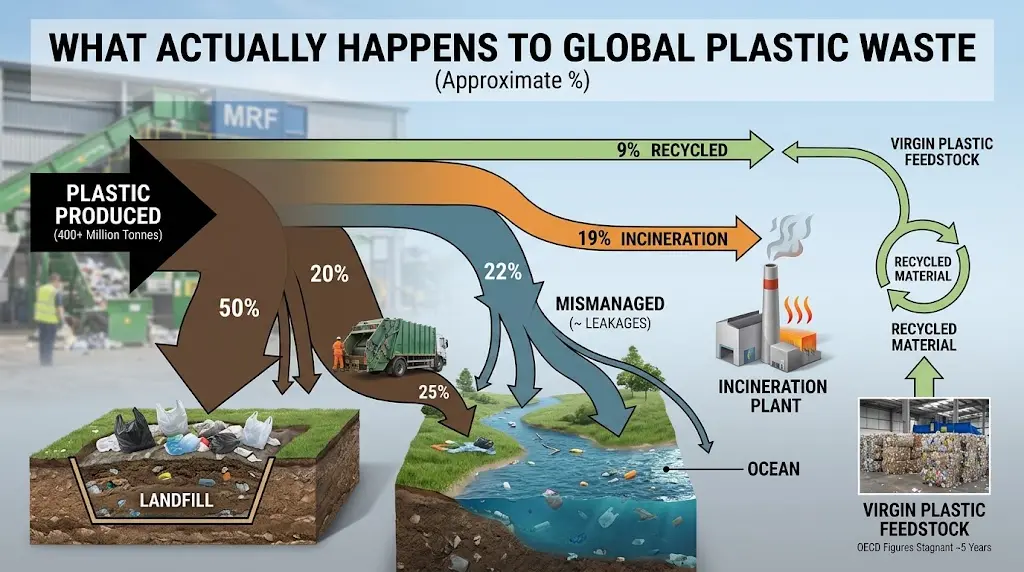
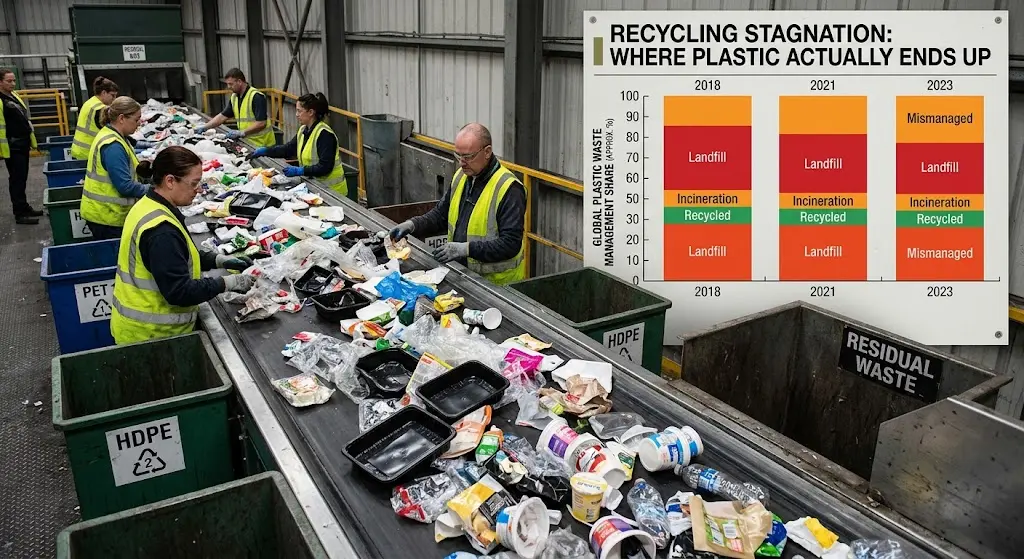
Here is where a lot of well-intentioned effort gets misdirected. Global recycling rates for plastic sit under 10 percent, and that number has been described as “stagnant” in recent trade-flow analyses. In 2022, only about 9.5 percent of the roughly 400 million tonnes of new plastic produced came from recycled material. The rest was made from fresh fossil fuel feedstock, recycling bins notwithstanding.
The breakdown of what happens to plastic waste globally looks roughly like this:
| Disposal Method | Approximate Share |
|---|---|
| Landfill | ~50% |
| Incineration | ~19% |
| Recycled | ~9% |
| Mismanaged (open dumps, leakage into environment) | ~22% |
The United States performs worse than the global average, with independent estimates putting the domestic recycling rate closer to 5 to 6 percent. Contamination, sorting costs, and the fact that most plastic types cannot be recycled together are the practical reasons why. PET bottles and HDPE containers are the two plastics that actually get recycled at meaningful rates. Nearly everything else, including most flexible film and mixed-material packaging, ends up in the landfill or incineration column regardless of which bin it was placed in.
This is not an argument against recycling. It is an argument for treating it as the last resort it actually is, rather than the solution it gets marketed as. Reducing what comes into the house in plastic form does more than sorting what leaves it. If you want to see what that reduction looks like in practice, what happens to your trash after a month plastic-free is a useful, concrete look at the difference.
3. The Health Angle Is Real, But It Is Still Developing
Microplastics have now been found in human blood, lungs, and placental tissue, and in atherosclerotic plaque removed during surgery. That part is well documented. What is not yet settled is causation. Researchers have not proven that microplastic presence in these tissues directly causes disease, and most of the strongest mechanistic evidence — oxidative stress, inflammation, disruption of lipid metabolism — comes from cell and animal studies rather than long-term human data.
A 2025 study using mice did show microplastics moving through brain tissue and interfering with blood vessels, and the authors themselves cautioned that it would be premature to assume the same process happens the same way in a human brain. That caution is worth repeating rather than skipping past for a punchier headline. The honest summary is this: the biological plausibility of harm is strong and growing, the direct proof in humans is not there yet, and neither of those facts is a reason to wait around before reducing exposure where it is easy to do so.
Where people usually go wrong here is treating every plastic product as equally risky. Heat is a major driver of microplastic and chemical migration, which is why a plastic container in the dishwasher or microwave is doing more damage than one sitting in a cool cupboard. If storage swaps are on your radar, glass versus stainless steel for plastic-free storage covers the practical trade-offs better than a blanket “throw out all your plastic” instruction would.
4. Zero Waste and Plastic-Free Are Not the Same Goal
This is the mix-up that trips up more beginners than anything else on this list. Zero waste is about total material flow, including food waste, paper, and everything else that goes into a bin. Plastic-free is narrower and more specific. You can run a genuinely low-waste household that still uses some plastic, and you can eliminate the vast majority of plastic from your home while still producing compostable or paper waste elsewhere. Treating the two as interchangeable is how people end up overwhelmed in month one, trying to solve two different problems with one set of swaps.
A rough progression that tends to hold up under actual use, not theory:
- Start with the highest-volume, lowest-effort category: kitchen storage and food packaging.
- Move to bathroom products, where microplastic exposure through rinse-off items is highest.
- Address cleaning supplies, which are often sold in plastic purely out of habit rather than necessity.
- Leave the hardest, lowest-impact category — things like electronics casings — for last, or accept them as a reasonable limit.
That order matters more than most people expect. Attacking the hardest category first is a fast way to burn out, and burnout is a bigger threat to long-term plastic reduction than any single non-recyclable item is. Plastic Free Living has covered this sequencing in more detail, including the most common mistakes beginners make in month one, which is worth reading before you reorganize an entire kitchen over a weekend.
Where the Real Leverage Is
None of this means individual action is meaningless, and it would be dishonest to end on that note given how much of Plastic Free Living’s own reporting is built around exactly these swaps working. But the leverage is uneven. Refusing single-use packaging before it enters your home does more than trying to sort it correctly after the fact, because sorting mostly fails at the system level regardless of individual effort. Choosing durable, repairable goods over disposable ones removes demand at the source rather than managing waste at the end.
The data is not encouraging if the goal is “the system will fix this through recycling.” It is genuinely encouraging if the goal is “reduce what I personally bring into my home and hold companies accountable for the rest.” Those are different bets, and only one of them is actually paying off right now.
Frequently Asked Questions
Is it even worth going plastic-free if recycling rates are this low? Yes, but not because your individual bin makes a dent in the 9 percent figure. Reducing plastic at the point of purchase avoids the recycling system entirely, which is more effective than hoping a low-performing system processes what you throw away.
Which plastics are actually worth recycling, and which aren’t? PET (bottles, most food jars) and HDPE (milk jugs, some tubs) have the highest real recycling rates. Flexible film, black plastic, and mixed-material packaging are rarely recycled in practice even when the bin accepts them, so reducing those categories matters more than sorting them carefully.
Do microplastics actually cause disease, or is that overstated? The presence of microplastics in human tissue is confirmed. A proven causal link to specific diseases in humans is not yet established, though the animal and cell-level evidence for harm is substantial enough that caution is reasonable while research continues.
What’s the single highest-impact swap for a household just starting out? Food storage and packaging, because it is the highest-volume category and the easiest to replace without lifestyle disruption. Bathroom and cleaning products tend to matter more for direct exposure but are lower volume.
Is bamboo or silicone actually a good plastic alternative? It depends on the product and how it is made; some “bamboo” items are bamboo fiber bound with plastic resin, which defeats the purpose. Worth checking before assuming a natural-sounding material is automatically plastic-free.
For more on this, plasticfreeliving.online has a broader breakdown of which plastic-free swaps hold up under real household use, not just marketing claims.