
Plastic Packaging: Why Is It on Nearly Everything?
Ninety percent of what you bought this week came wrapped in something that will outlive you. That’s not exaggeration for effect, it’s roughly where the numbers land once you count flexible film, rigid trays, blister packs, and the little plastic window cut into an otherwise cardboard box. Before I started writing about waste full time, I spent a few years on the sourcing side of a mid-size food brand, sitting in meetings where packaging decisions actually got made. The question I get asked more than any other, in some form or another, is why everything has to be wrapped in this stuff. The honest answer isn’t dramatic. It’s mostly about money, and once you see that, a lot of the rest starts making sense.
1. It Comes Down to Cost, Not Convenience
Plastic packaging didn’t win because it protects products better than everything else. It won because it’s cheap to make, light to ship, and it runs on machinery that a lot of manufacturers already own. A glass jar costs more per unit than a flexible pouch, weighs more on a truck, and breaks. A cardboard box needs a liner if it’s going anywhere near liquid or grease. Plastic film, on the other hand, can be produced by the mile, formed into almost any shape, and sealed in fractions of a second on lines that have been running the same way for decades.
That’s the part people miss when they assume some evil committee sat down and chose plastic out of malice. Nobody chose it out of malice. A packaging engineer chose it because it hit a cost-per-unit target, and once a supply chain is built around a material, switching it out means retooling factories, requalifying suppliers, and eating months of production downtime. Companies don’t do that unless they’re forced to, or unless the alternative becomes cheaper, which for most of the last fifty years it simply hasn’t been.
If you’re just getting into this and wondering where to even start untangling it in your own kitchen, I’d point you toward where to actually begin with plastic-free living rather than trying to fix the whole supply chain in your head first. Start small. The industry moves slowly, but your own shelves don’t have to.
2. The Shelf-Life Excuse Actually Holds Up, Sometimes
Here’s where I’ll push back on my own side of the argument a little. Not all of this is corporate laziness. Plastic film genuinely does extend shelf life for a lot of perishable goods, and that matters more than people want to admit. A cucumber wrapped in a thin layer of shrink film loses moisture about three times slower than an unwrapped one, which sounds trivial until you’re a grocery chain trying to reduce spoilage across thousands of stores. Food waste has its own massive environmental cost, and in some cases the plastic wrap is actually the lower-impact choice once you account for what gets thrown out otherwise.
But. And this is a big but. That legitimate use case gets used to justify an enormous amount of packaging that has nothing to do with shelf life. Individually wrapped crackers inside an already-sealed box. A banana in a plastic tray with cling film over the top. Six juice boxes shrink-wrapped together, then placed inside a cardboard case, which is then shrink-wrapped again for the pallet. Some of it is functional. A lot of it is just habit dressed up as function, and it’s worth learning to tell the difference before you assume every wrapper on a shelf is doing real work.
This is also usually where people confuse two ideas that sound similar but aren’t. If you’ve ever gotten tangled up trying to figure out the actual difference between going plastic-free and going zero waste, this is a good moment to sort that out, because the shelf-life question sits right at the intersection of the two.
3. Where the Recycling Symbol Lies to You
Here’s where people usually go wrong, and it’s not really their fault. That little triangle of chasing arrows on the bottom of a container was never a promise that the item gets recycled. It’s a resin identification code, created by the plastics industry itself in the 1980s, and it tells you what the plastic is made of, not what happens to it after you toss it in the bin.
| Code | Common Name | Typical Items | Realistically Recyclable? |
|---|---|---|---|
| 1 (PET) | Polyethylene terephthalate | Water bottles, soda bottles | Yes, widely accepted |
| 2 (HDPE) | High-density polyethylene | Milk jugs, detergent bottles | Yes, widely accepted |
| 3 (PVC) | Polyvinyl chloride | Some cling wraps, pipes | Rarely, most facilities reject it |
| 4 (LDPE) | Low-density polyethylene | Bread bags, squeeze bottles | Sometimes, check locally |
| 5 (PP) | Polypropylene | Yogurt tubs, bottle caps | Increasingly, but inconsistent |
| 6 (PS) | Polystyrene | Foam trays, disposable cups | Almost never |
| 7 (Other) | Mixed or layered plastics | Chip bags, squeeze pouches | No, essentially unrecyclable |
Codes 1 and 2 make up the bulk of what actually gets processed in most municipal systems. Everything past that is a coin flip depending on where you live, and code 7 is basically a catch-all for materials nobody has figured out how to reprocess economically. Plastic Free Living gets messages weekly from readers who feel guilty for throwing something in the trash that had a recycling symbol on it. You shouldn’t. The symbol was never built to tell you the truth, it was built to make sorting easier for facilities that can actually use the information, and most consumers were never the intended audience.
4. The Industry Isn’t Going to Fix This on Its Own
Some regions have started forcing the issue through extended producer responsibility laws, which shift the cost of packaging waste back onto the companies that generate it instead of leaving it entirely with municipal recycling programs. Where those laws exist, packaging design tends to shift fairly quickly toward materials that are actually processable, because suddenly there’s a financial reason to care. Where they don’t exist, packaging stays exactly as wasteful as it’s cheapest to be.
That’s not cynicism, it’s just how the incentives are built. And it means the pace of change in your own grocery store depends more on your local or national policy environment than on any individual brand’s stated values. A lot of the beginner mistakes I see people make come from assuming that avoiding plastic is mostly a personal willpower problem, when it’s really a structural one layered on top of a personal one. If you want a fuller picture of the traps people fall into in their first few months of trying to cut back, this rundown of common early missteps covers a lot of the same ground I hear about in emails.
5. What Actually Moves the Needle at the Register
None of this means individual choices are pointless, they’re just aimed at a smaller target than a lot of people assume. A few things genuinely help, in rough order of impact.
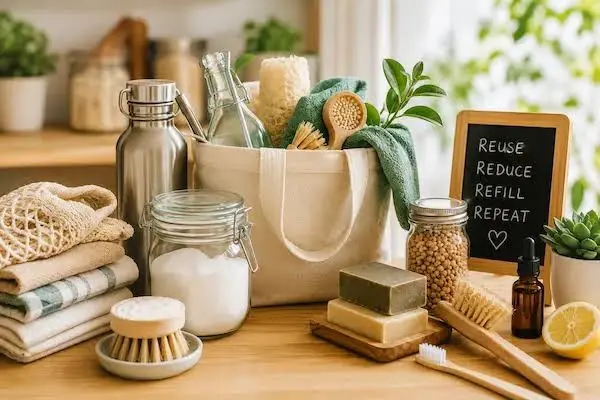
Buying less processed food cuts packaging volume more than almost any single swap, since processing is usually where multiple layers of plastic get added. Bulk bins, where they exist, let you skip packaging entirely for staples like rice, oats, and legumes. Concentrate and refill products for things like cleaning supplies and soap reduce the plastic per use by a wide margin, because you’re not shipping and packaging mostly water every time. And glass jars, once you’ve got a small collection going, can replace a surprising number of plastic containers in a kitchen without much effort.
If you’re not sure where to start swapping things out physically, this list of first swaps for beginners is a reasonable place to look, and it pairs well with sorting out which “eco” materials are actually doing what they claim, since not everything marketed as an alternative holds up under scrutiny either.
I get asked constantly whether switching to bamboo everything solves the problem, and the honest answer is more complicated than the marketing suggests. I wrote a longer breakdown of whether bamboo products are really as plastic-free as they’re sold to be if you want the fuller version of that argument.
None of these swaps will get your household to zero plastic, and I’d be lying if I said mine has gotten anywhere close either. What they do is cut volume in the places where volume is easiest to cut, which is usually a better use of energy than trying to eliminate every last piece of film from your life in month one.
Plastic Free Living exists because a lot of this information is scattered, contradictory, or written by people trying to sell you something. It’s not, and it doesn’t have to be perfect to be worth doing.
FAQs
Is all plastic packaging actually recyclable if my city’s program accepts it? Not necessarily. Municipal programs often accept a wider range of plastics than their sorting facilities can actually process, partly to keep collection simple for residents. Items that can’t be efficiently sorted or sold to a reprocessor frequently get landfilled after collection, even though they went in the right bin.
Why do fruits and vegetables get shrink-wrapped when they already have a peel or skin? Mainly to slow moisture loss and physical damage during transport and storage, which reduces spoilage. It’s a legitimate function for some produce, cucumbers being a commonly cited example, though it’s applied far more broadly than the actual shelf-life benefit justifies.
Are packages labeled “compostable” actually compostable at home? Usually not. Most compostable plastics are designed for industrial composting facilities that reach higher, more consistent temperatures than a backyard bin. Left in a home compost pile, many of them break down slowly or not at all, and some can contaminate the batch.
What’s the single packaging swap that makes the biggest difference? Buying less processed food. Processing steps are usually where extra packaging layers get added, so shifting toward whole or minimally processed ingredients cuts volume more reliably than swapping any one material for another.
Will companies switch away from plastic packaging without being required to? Rarely, and not quickly. Packaging changes are expensive to implement, and companies generally move on this only when regulation, real cost shifts, or sustained public pressure make the current approach more expensive than the alternative.
You don’t need to fix the whole supply chain to make a dent in your own kitchen, and honestly, most weeks I’m just trying to keep up with my own rules too.