
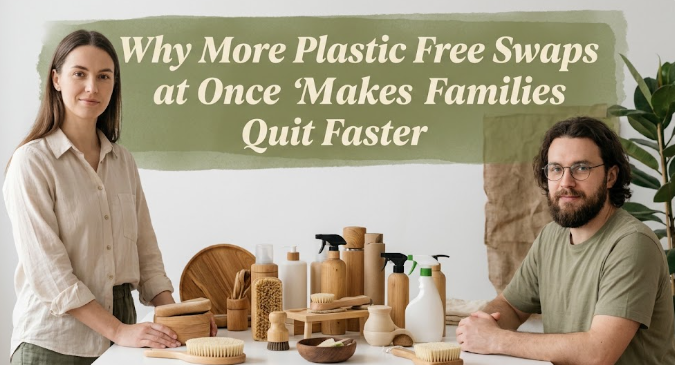
Why More Plastic Free Swaps at Once Makes Families Quit Faster
Most households that quit going plastic free don’t quit because it’s hard. They quit because they tried to do all of it in the same week.
We see this pattern constantly at plasticfreeliving.online. Someone gets motivated on a Sunday, watches a few videos, reads a list of “50 plastic free swaps to try today,” and by Wednesday their kitchen counter has three half finished projects and a family that’s annoyed with them. The bamboo toothbrushes are in a drawer because nobody likes them yet. The bulk bin containers are still in the car. The reusable produce bags got left at home twice in a row, so they gave up and grabbed plastic ones anyway. That’s not a motivation problem. It’s a sequencing problem.
There’s a persistent myth in this space that more effort equals more progress, and that going all in shows commitment. It doesn’t. It shows enthusiasm, which is a different thing entirely, and enthusiasm has a much shorter shelf life than habit.
- The Myth: More Swaps, Faster Results
The logic sounds reasonable on paper. If one swap reduces plastic waste by a small amount, then ten swaps should reduce it by ten times as much, and doing them together should get a household to “plastic free” faster than doing them one at a time. This is how a lot of beginner guides are written, including some of the worse ones floating around this niche. Swap your cling wrap, your sponges, your shampoo bottles, your food storage, your cleaning products, and your snack bags, all in the same month, and watch your trash shrink.
What actually happens is different. Each swap isn’t just a purchase. It’s a new decision point that has to be relearned until it becomes automatic. Where do the beeswax wraps live. How do you clean them. What do you do when you forget the produce bags at home. Every one of these micro decisions takes working memory, and working memory is a limited resource in a busy household. Stack ten of them at once and none of them get the repetition needed to become habit. They stay effortful. Effortful things get dropped the first time life gets busy, and life always gets busy.
- Why This Backfires Specifically for Families
Families have more failure points than individuals, and that’s worth saying plainly. A single adult living alone only has to convince themselves. A household has to get buy in from a partner, coordinate with kids who don’t care about plastic reduction and just want their snack in the bag they recognize, and survive the chaos of mornings where nobody has time to remember which container goes where.
When five or six new systems get introduced simultaneously, at least one family member becomes the bottleneck. Maybe it’s a kid who refuses the metal straw. Maybe it’s a partner who keeps buying the old brand out of habit because nobody told them the new one lives on the second shelf now. One broken link in a chain of new habits creates friction, and friction in front of children tends to get narrated out loud. “Ugh, this is so annoying,” said once in front of a seven year old, does more damage to a plastic free effort than any single piece of plastic ever could.
Beginners often confuse a slow start with a weak commitment, which is exactly the kind of misconception we walk through in the common mistakes families make in month one. Slow is not the same as weak. Slow is what durable actually looks like.

- What Sequencing Actually Looks Like
Here’s where people usually go wrong, and it’s worth naming directly: they choose their swaps based on what feels impactful instead of what’s easy to repeat. Reusable coffee cups feel meaningful because they’re visible and social. But if your household drinks coffee at home nine times out of ten, that swap barely touches your actual plastic volume. Meanwhile something boring, like switching to bar soap instead of bottled body wash, might cut more plastic and take zero behavior change to maintain, because you already know how to use soap.
A workable order looks something like this. Pick the single swap that touches your household most often, not the one that looks best on a shelf. Give it two to three weeks before adding anything else, long enough that it stops requiring a decision and starts just happening. Only then add the next one. This isn’t a purity test and it isn’t a race. If you’re not sure where the highest impact starting point is for your own kitchen, that’s covered in more depth over on the swaps every beginner should try first, which breaks it down by how often each item actually gets used rather than by how satisfying it feels to buy.
And yes, the first week of any single swap usually feels harder than people expect. That’s normal. It’s covered in why week one feels harder than expected, and it passes faster than people assume once there’s only one new thing to think about instead of six.
- A Side Note on Motivation Timing
There’s something worth mentioning here that doesn’t fit neatly anywhere else. The Sunday-night surge of motivation that makes people want to overhaul the whole kitchen at once is real, and it’s not something to fight or suppress. But it’s also not a reliable fuel source. It burns hot and fast. The move isn’t to ignore that burst of energy, it’s to redirect it. Use Sunday night’s motivation to plan the order of your swaps for the next two months, not to buy everything on Amazon in one cart. Write the list. Then let the actual swapping happen slowly, on its own schedule, long after the initial burst has faded. That’s the version of the plan that survives contact with a Tuesday morning school run.
- What This Looks Like Side by Side
| All-at-Once Approach | One-at-a-Time Approach | |
|---|---|---|
| Week 1-2 | 6+ new systems introduced | 1 swap introduced |
| Family friction | High, multiple bottlenecks | Low, one adjustment point |
| Habit formation | Interrupted before automatic | Reaches automatic use |
| Typical outcome by week 6 | Partial abandonment of most swaps | Full retention of first swap, second one starting |
| Emotional tone | Overwhelm, guilt when swaps slip | Small, repeated wins |
The households that stick with this long term almost always look like the right column. They’re not doing less. They’re doing it in an order that actually holds.

Common Mistakes Worth Naming Directly
The biggest one, again, is starting with the swap that photographs well instead of the one that gets used daily. A close second is buying replacement products before removing the plastic ones already in rotation, which just means two systems competing in the same drawer. And a third, specific to families, is introducing a new system without explaining the “why” to the kids in a way that makes sense to them, which turns every use of the new item into a small negotiation instead of a normal part of the day.
If you’re still working out where to even begin, the beginner starting point guide lays out a reasonable first month without assuming anything gets thrown out overnight.
None of this means big change is impossible or that plasticfreeliving.online is telling you to move at a snail’s pace forever. It means the fastest route to a genuinely low plastic household isn’t the one that feels fastest in week one. It’s the one that’s still running in month six, quietly, without anyone in the house complaining about it anymore.
FAQs
Is it really worse to do multiple swaps at once, or does it just depend on the person? It depends somewhat, but the pattern holds across most households we’ve seen. People with fewer competing responsibilities, like someone living alone with a flexible schedule, can sometimes absorb three or four swaps at once. Families with kids, shared kitchens, or unpredictable schedules almost always do better sequencing one at a time.
How long should I actually wait before adding the next swap? Two to three weeks is a reasonable minimum, and longer isn’t a problem. The signal to look for isn’t a date on a calendar, it’s whether the swap has stopped requiring a conscious decision. Once you reach for the beeswax wrap without thinking about it, you’re ready to add the next thing.
What if my kids refuse a swap completely? Don’t force it, and don’t treat it as a household-wide failure. Swap what you control directly, like your own products, and let kid-facing swaps happen more gradually with their input. A snack bag they chose themselves gets used. One forced on them gets left in a backpack.
Does it matter which swap I start with? Yes, more than most guides admit. Start with whatever gets used most often in your specific household, not whatever seems most symbolic. A family that orders takeout twice a week will get more out of tackling that packaging than swapping a rarely used product.
Is there a point where doing more at once actually is fine? Usually once the first two or three swaps are fully automatic and causing zero friction. At that point, a household has some spare capacity, and adding two things together becomes more reasonable than it would have been in week one.