My son came home in the second week of September without his lunch container. Not lost, he insisted. Traded. He’d swapped it for a bag of chips because the other kid’s snack looked better than a squished sandwich wrapped in beeswax that had gone slightly tacky in the heat. That was the moment I stopped trying to make plastic-free lunches look impressive and started trying to make them work.
There’s a difference between a lunch that photographs well and a lunch that actually comes home eaten, with the container still inside the bag. Most of the plastic-free advice floating around online is built for the first goal. This is about the second one.
1. Why Kids Trade Away Their Lunch Containers (Or Just Lose Them)
Kids don’t reject plastic-free lunches because they object to the environmental logic. They’re seven. They reject them because the food inside is soggy, the container is hard to open one-handed while talking to a friend, or because a classmate’s lunch simply looks more interesting. Trading and losing are the same problem wearing different clothes: the lunch didn’t hold its own at the table.
Beeswax wraps are a good example of something that works beautifully at home and falls apart under school conditions. They soften in heat, they don’t seal as tightly as a lid, and a nine-year-old is not going to carefully refold one before shoving it back in a backpack. I still use them for snacks that get eaten by 10 a.m. I stopped using them for anything meant to survive until lunch period at 12:30.
This is where a lot of people going plastic-free stumble. If you’ve read the common mistakes beginners make in their first month, you’ll recognize the pattern: swapping every plastic item at once, for the most “authentic” plastic-free option, without testing whether it survives actual use. A lunchbox is a stress test in miniature.
2. What Actually Makes a Lunch “Plastic-Free” (Not Just Bamboo)
Bamboo shows up everywhere in this niche, and it’s worth being honest about it. A lot of bamboo lunch gear is bamboo fiber composite, which is bamboo powder bound together with melamine resin, a plastic. It’s not the same as a solid bamboo cutting board. I’ve written more on this over on the site’s piece about whether bamboo is really plastic-free, and the short version is: check the material listing, not the marketing photo.
Plastic-free, for a school lunch, really means three things. The container doesn’t leach anything into hot food. It doesn’t rely on single-use wrap to close. And it survives a dishwasher, a backpack, and being sat on at least once a semester. Stainless steel and tempered glass meet all three. Most “eco” plastic alternatives meet one or two.
None of this means the food has to look Instagram-ready. Some of the least photogenic lunches I’ve packed, a plain stainless tiffin with rice and beans, a jam sandwich in a silicone pouch, have had the best return rate. Empty container, no complaints, home by 3:15.
3. What Actually Survives a School Day
Here’s where I’ll save you some money. I bought four different “eco lunch systems” over two years before settling on what’s below.
| Container type | Holds up to school day | Leak resistance | Realistic lifespan | Best for |
|---|---|---|---|---|
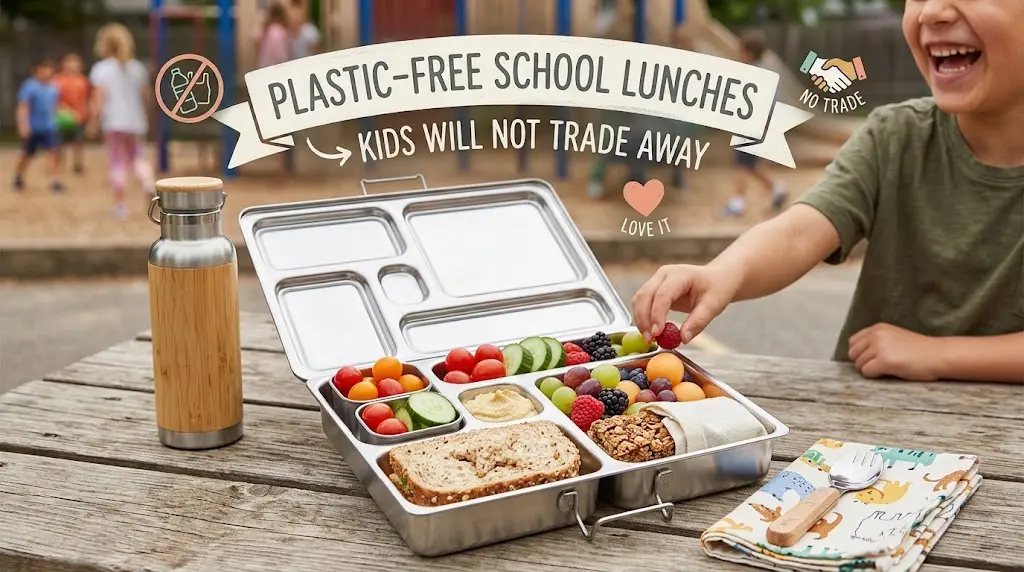
| Stainless steel bento box | High | Good with silicone seal | 3-5+ years | Hot or cold mains |
| Tempered glass with locking lid | High | Very good | 3-5+ years, until dropped | Reheated lunches |
| Silicone pouches | Medium | Good, dries slowly | 1-2 years | Wet snacks, purees |
| Beeswax wrap | Low for full meals | Poor once warm | 6-12 months | Dry snacks, short storage |
| Bamboo fiber composite | Medium | Depends on lid design | 1-3 years | Dry sides, not liquids |
The stainless steel bento box has been the single best purchase in five years of packing lunches. It also happens to be the first thing I’d point a beginner toward, and it’s on the site’s list of swaps every beginner should try first, for good reason. It’s boring. Boring is what survives a backpack.
I want to be clear about something people get wrong constantly: you do not need to replace everything in the same month. Plastic-free living isn’t a renovation, it’s closer to a slow swap-out as things wear out. If money’s tight, start with one solid container and one water bottle. That’s most of the daily plastic use for a school-aged kid anyway. There’s a longer breakdown on the site about doing this on a tight budget if that’s where you’re starting from.
4. Building a Routine Kids Will Actually Keep
The container matters less than the routine around it, and this is the part almost nobody writes about.
Kids lose and trade things when the system asks too much of them mid-day. A container with six separate parts, a wrap that needs refolding, a bag within a bag within a bag, all of that adds friction at exactly the moment a kid has four minutes and a full cafeteria around them. Fewer parts wins. Every time.
What’s worked for us, and for most of the families I hear from:
- One container, one compartment or two at most, no loose lids to track down
- A water bottle that clips to the backpack instead of living loose inside it
- Snacks pre-portioned the night before, so mornings aren’t a negotiation
- A rule that empty containers come straight out of the backpack at pickup, not three days later smelling like regret
And yes, kids still trade snacks sometimes. That part isn’t fixable with better gear. It’s just what happens in a cafeteria.
Common Mistakes Worth Naming Directly
The biggest one I see, in my own early attempts and in messages from readers, is buying the “complete plastic-free lunch kit” before testing a single piece with your actual kid. Some children want compartments. Some want everything mixed together. Some will not use a container with a lid that snaps instead of clicks, for reasons no adult will ever understand. Buy one piece. Watch how it survives a week. Then decide.
A close second: assuming a product is plastic-free because the packaging says “eco” or “natural.” Check the actual material. A quick search on the brand’s own spec sheet takes thirty seconds and saves you from another drawer of half-used gear.
Plastic Free Living gets messages fairly often from parents who feel like they’ve failed because a swap didn’t work. It didn’t fail. It just wasn’t the right swap for that particular kid, in that particular backpack, on that particular bus ride home.
FAQs
Is stainless steel actually safe for hot food at school temperatures? Yes. Food-grade stainless steel doesn’t react with acidic or hot foods the way some plastics can under heat, and it holds temperature reasonably well for a few hours, though it’s not designed as a thermos replacement for soups.
My kid refuses to use anything that isn’t the container their friends have. What do I do? Let function follow social pressure a little. A stainless bento box in a fun color solves more problems than an unbranded eco container that gets left in the classroom out of embarrassment.
Are silicone lunch bags actually plastic-free? Food-grade silicone is a different material from plastic, made from silica rather than petroleum, and it doesn’t break down into microplastics the same way. It’s a reasonable middle step, though solid materials like glass or steel still hold up longer.
What’s the single best first swap if I can only change one thing? The main container. It’s used every single school day, unlike wraps or bags that vary by what’s packed, so it has the biggest impact on both plastic use and how much survives the year.
How do I stop losing containers entirely? You mostly don’t, not completely. Labeling helps, a consistent “empty it now” rule at pickup helps more, and choosing containers a kid actually likes using cuts losses by a wide margin in our experience.
The lunch that gets traded away isn’t a sign you’re doing this wrong. It’s just information. Watch what comes home half-eaten, what comes home not at all, and what container survives without a fight, and build from there. That’s the whole method, really. Everything else is just gear.